Abstract
Achieving multi-lead electrocardiography (ECG) in consumer-grade wearables remains a major challenge because most devices provide only a few electrodes and cannot capture spatially diverse cardiac signals. Conventional 12-lead ECG, though clinically standard, requires ten electrodes attached to different body locations, confining its use to medical environments.
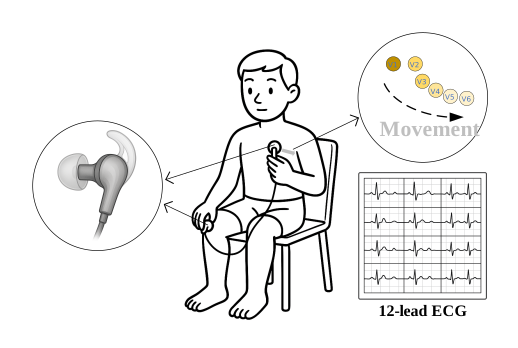
To bridge this gap, we present EarSleeve, a modular dual-electrode eartip sleeve that transforms off-the-shelf earphones into a 12-lead ECG sensing platform through a human-in-the-loop design. Each sleeve embeds two soft conductive electrodes and electrically links the left and right sides, forming a four-electrode configuration. EarSleeve simultaneously records all six standard limb-lead signals and, by sequentially contacting six standard chest regions with natural human motion, reconstructs 12-lead-equivalent ECG signals using only four electrodes.
In a user study, EarSleeve successfully captured clear ECG waveforms across all limb and chest leads and was evaluated against an FDA-cleared 12-lead ECG reference. The analysis included waveform morphology comparison using correlation metrics and medical-level assessments of extracted parameters such as RR interval, QRS duration, and R-wave axis. The results confirm that EarSleeve achieves high signal consistency and preserves diagnostic features across all leads. We further release the paired EarSleeve—12-lead dataset to support reproducible evaluation of earphone-based ECG sensing. These findings demonstrate that commercial earphones can be repurposed as distributed cardiac sensors through simple modular augmentation, opening new opportunities for accessible and unobtrusive health monitoring.
Earphone Design


This design builds on a simple idea: instead of placing ten electrodes at once, a wearable can reuse a small set of electrodes at different body locations over a short period. Our system takes advantage of natural user interaction to sequentially gather spatial ECG information, enabling a four-electrode approach to recover all 12 clinical leads. Three electrodes provide stable limb references, while a fourth is briefly moved across the chest positions. We implement this with dual-electrode eartip sleeves that attach to ordinary earbuds, adding two skin-contact points per earpiece and an internal link that forms a unified four-electrode network. The hardware includes four AD8232 front-ends that capture the limb and chest potentials with proper impedance balancing, all digitized by an nRF52840. Users simply hold the earbuds at limb sites, then move one electrode across V₁–V₆, allowing the system to reconstruct full 12-lead-equivalent ECG using natural, hand-guided motion.
Comparison Against ECG Measured by Medical Device


A lead III ECG signal measured using the medical device and the same lead III ECG signal measured using our method.
We evaluated our system in a controlled study with 12 participants by recording simultaneous data from a clinical 12-lead ECG and our ear-worn device across all limb and chest positions. After filtering and precise alignment, the reconstructed leads showed strong waveform agreement with the clinical reference, with correlations around 0.90–0.97. Key diagnostic metrics—including RR interval, QRS duration, and cardiac axis—matched closely as well, with only small, clinically negligible differences. Additional tests comparing seated and supine recordings showed posture had no meaningful impact on signal quality.

Related Links
BibTeX
@misc{xia2026ear, author = "{Junxi Xia, et. al.}", title = "EarSleeve: Transforming Earphones into 12-Lead ECG Sensors", year = "2026", howpublished = "\url{https://ear-sleeve.github.io}",}